GO Transit has a major problem: the prices.
Actually, it’s a bigger problem than that, so let me start there: Too many people. In the last 15 years, the Greater Toronto Area has grown by at least 1.2 million people. (Keep in mind that Canada’s entire population is only about 38 million.)
That’s upwards of 400,000 new homes. More roads. Way more cars.
And all those cars are highly visible on the roads. I’ve seen this for the last few visits to the GTA, where highways do not move quickly at all. They were bad in the 90s when I used to live here; now, they’re doubled in volume without a suitable doubling of capacity.
For the record, I am not advocating for more highways. But I do recognize that there is a pressing need to move people more efficiently.
The Government of Ontario recognized this back in the late 1960s, before I was born, creating GO Transit . It was small and limited, but like with many great things, you don’t start off with the full-meal deal. It was a few former Greyhound busses, single level train cars with only a few trains a day along the Lakeshore lines.
Today, Union Station – the central hub for GO Trains coming into downtown Toronto – boasts over 250,000 people going through every weekday, and the entire population of Canada two times over every year (about 72 million). That’s an impressive number – the second highest usage in North America after New York’s Penn Station, more than Grand Central Terminal.
Except. It’s one station. The station. Toronto really only has one major one. There are smaller stops around the outside, but by and large almost all come into Union. When looking at the city level, New York is over 160 million more people than Toronto.
Doing this with other North American cities, Chicago (which has three stations) leaps to #2, with 15 million more transits than Toronto. Here’s the interesting thing: Chicago and Toronto are very close analogues in size and population distribution. Although Toronto and Chicago are roughly the same age, Chicago had its growth spurt nearly 100 years before Toronto, at the height of rail travel and commuting. METRA (then the Chicago, Burlington, and Quincy, a precursor to today’s BNSF) had double-decker trains nearly two decades before the first GO Train pulled into Union Station.
Like Toronto, Chicago has redeveloped itself around highways, as the car is still the prominent form of transportation in North America. But it didn’t reduce rail traffic, and with more and more cars on the road, trains became more and more the valve to relieve pressure on the morning and evening commutes.
From Oakville to Toronto will run you $11.40, not counting Presto discounts. Chicago is $6.25. (I am also ignoring exchange, treating this as dollar-for-dollar.) METRA’s tickets are subsidized up to 80% of its face value; GO Train about 62%.
The key difference? Ridership. METRA handles a lot more.
The Government of Ontario thinks that expanding highways is the way to manage congestion. It will never work. The only way to reduce traffic is to remove cars from the roads. There are ways to do that, the most famous (and controversial) method is congestion pricing. But do make that even remotely acceptable, you have to provide a reasonable alternative: affordable public transit.
The price of a GO Train ticket is far too high. It doesn’t matter what station you get on, if the price is exorbitant, people will prefer a “more flexible” method, even if it involves paying for parking and dealing with traffic. How do I know this? Look at all the cars on the roads. They’re not there by accident.
Public transit should not make money. Yes, it can, and has it has in some cases, but public transit is just like the roads: we pay taxes to support a system to allow the movement of people. Just in this case, we’re moving groups of people more efficiently by dramatically reducing the volume of cars, compressing all that unused, empty space (look at all the large vehicles on the road with a single person) and putting them in one, convenient place.
Reducing the prices 50% will also dramatically increase ticket compliance. When ticket prices rise, people tend to avoid paying. And since the system doesn’t gate every single person to prove a valid ticket, there’s no guarantee they’ve paid, and there’s no where near enough Special Constables to police valid fares (though their own investigations suggest over 5%).
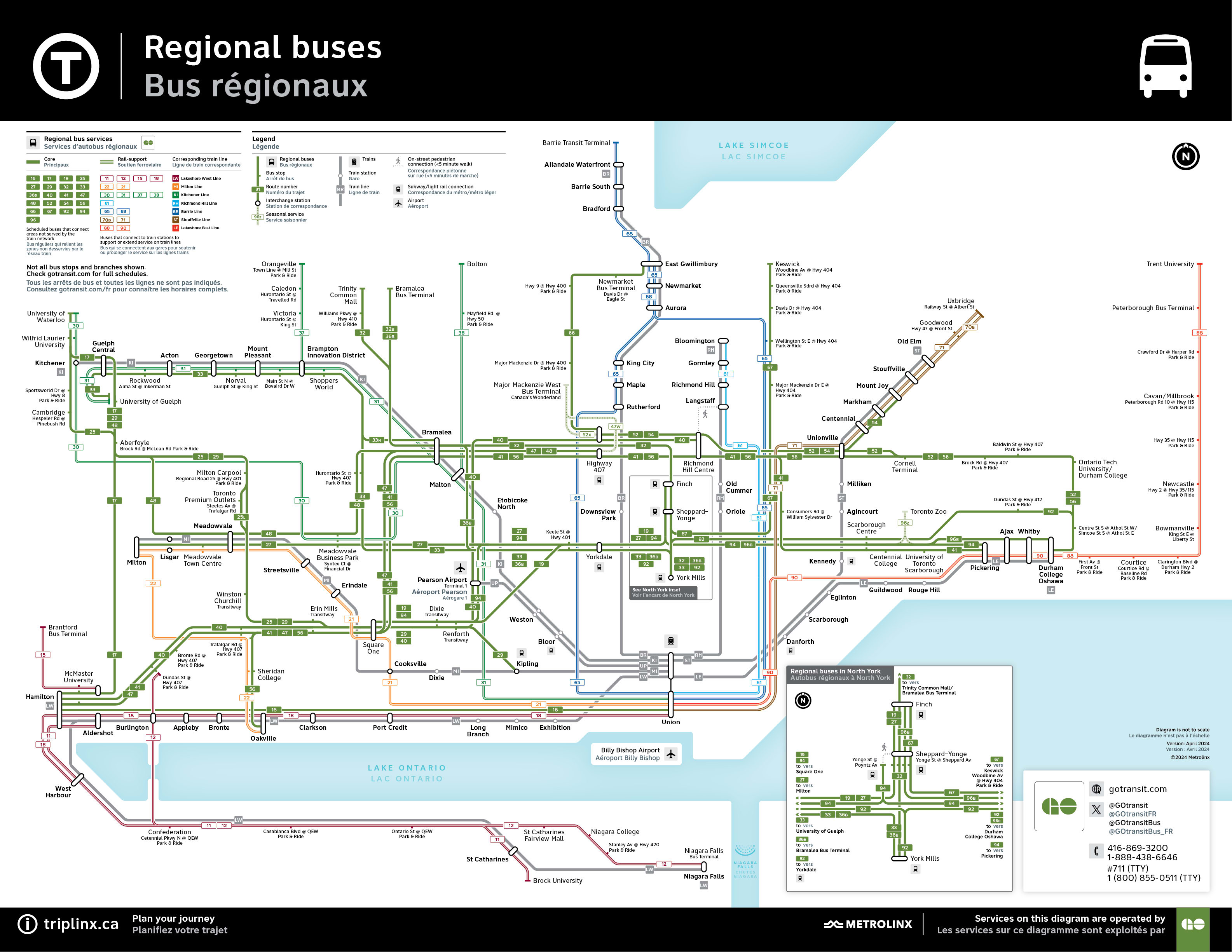
The GO Transit network (busses and trains) is extensive. It’s already present. Halve the prices (no, I’m not kidding) and influence more people to get out of their cars and onto regular, reliable service. Yes, there will be a period of lower revenue as a result – but lower prices encourages more purchases, more ridership.
And if it’s reasonable, the people will come. And GO.